Close Encounters in Chiang Mai

March 19, 2013

Chiang Mai was like a breath of fresh air from the pulsating and almost-dizzying energy of Bangkok. I felt as though the people were more gentle and there seemed to be more minutes in an hour. I flew into Chiang Mai at about 10 pm and was very pleased to find that the airport was just about a 20 minute drive to the city and to Amora Tha Pae, my hotel. I was glad to have included Chiang Mai in my Thailand trip. Before retiring for the night, I just had to squeeze in a visit to the Night market to get a little more feel of the Northern Thailand city but I didn’t stay out too late. The next day was to be a full day and I was going to need to rest.

An early morning stroll by the city's moat.

An early morning stroll by the city’s moat.

Morning came and I just had to take an early morning stroll out by the moat and get breakfast at one of the diners close to the hotel. On my list of things to do for the were the following: 1. Maesa Elephant Camp 2. A visit to the tribes village 3. Tiger Kingdom It was a stroke of luck that the hotel had an in-house tour company, Siam-Lanna Travel. It was even more good fortune, that my guide for the day, was no less than the very  accommodating proprietor of the company himself (which he only revealed to me later in the day), Mr. Nong.

Maesa Elephant Camp
The elephant show started with a parade of these gentle giants

The elephant show started with a parade of these gentle giants

Starting with a pleasant drive to the Elephant Camp, I thoroughly enjoyed the activities lined up for me. Especially the Elephant Show where you’d get blown away as you witness the elephants painting pictures beautifully. More than the show however, I enjoyed the awesome 45-minute elephant ride which took me to the hill-tribes village.

The elephants painted these themselves. It was truly a unique experience to have witnessed their talent and intelligence in action

The elephants painted these themselves. It was truly a unique experience to have witnessed their talent and intelligence in action.

After the show, I got ready to meet my ride for the day, Mae Hamphong. She’s already 32 years old and has given birth to 5 babies. At first the ride was a bit bumpy, but once I got the hang of it, the Mahout (the elephant driver) and I casually made conversation in friendly, broken English.

The Hill-tribe Village
About to start the 45 minute journey up the mountains of Maerim to see the hill-tribes.

About to start the 45 minute journey up the mountains of Maerim to see the hill-tribes.

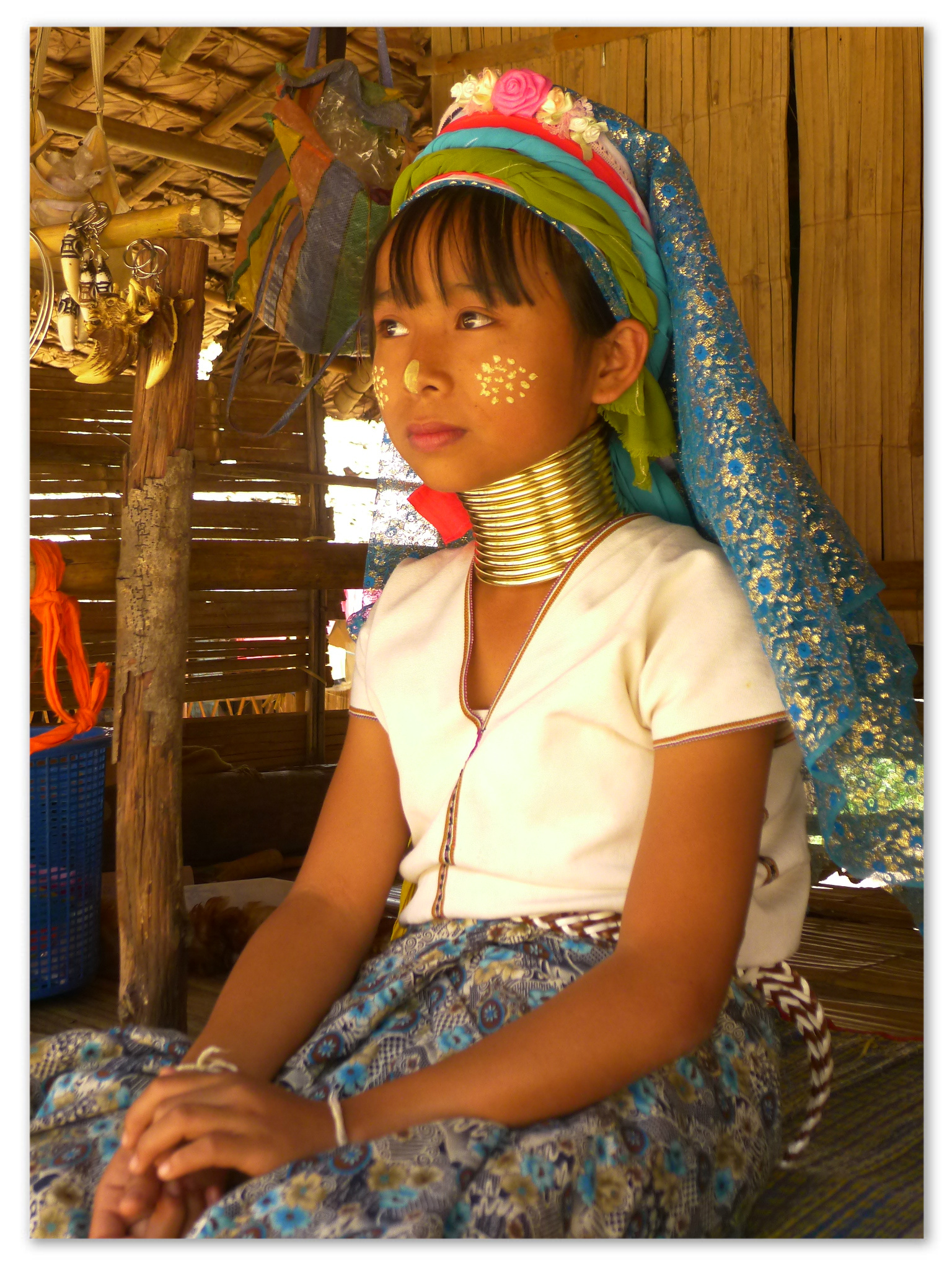
Mae Hamphong dropped me off at the entrance of the village where Mr. Nong was waiting for me. We walked into the village and met with the different indigenous tribes. Some have been relocated here from Myanmar (Burma) and have been given this area to settle in.  It was fascinating how each tribe had their own elaborate and distinctive costumes especially the Akha and the Padaung (the Long-Neck tribe).

An Akha selling hand-crafted souvenirs.

An Akha woman selling hand-crafted souvenirs.

The origins of the metal coil around the Padaung tribes' necks are more for protection than for aesthetics. When tigers attack, they usually go for the neck area, so to protect pregnant women and children who could not climb trees as fast as the rest, they wore these metal coils to protect themselves.

The origins of the metal coil around the Padaung or Long-Neck tribes’ necks are more for protection than for aesthetics. When tigers attack, they usually go for the neck area, so to protect pregnant women and children who could not climb trees as fast as the rest, they wore these metal coils to protect themselves and over time, the prolonged wearing of these coils caused them to have long necks, hence the English name of the tribe.

It took about an hour to go around the village and interact with the tribes. As per Mr. Nong, instead of giving the kids or the tribes-people money, it was more encouraged to purchase their wares instead. Giving the kids some candies would have been a great idea too but we didn’t bring any with us at the time. One more interesting thing I noted was that on top of the hill in the village, there was a Catholic Church made–apparently, these tribes-people have already been converted and baptized as Christians. Indeed, everywhere in Thailand, the mix of culture and religion is commonplace.

Mae Sa Butterfly and Orchid Farm/Restaurant
Beautiful orchids to behold while waiting for lunch.

Beautiful orchids to behold while waiting for lunch.

Famished after the activities of the first half of the day, Mr. Nong took me to the Orchid Farm, were a sumptuous lunch buffet was being served. The break from the heat was wonderful and gave me time to re-energize before I hit my next stop for the day, which will be in my next post, Tiger Kingdom.

An EXTREMELY Spicy Papaya Salad from tthe Orchid farm Restaurant.

Mr. Nong had me try an EXTREMELY Spicy Papaya Salad from the Orchid Farm Restaurant. I don’t know how many glasses of water I finished after. I could swear I could feel steam coming out of my ears.

In retrospect, the day was hot and tiring but it was energy well-spent. I cannot wait to come back to Chiang Mai with my family! Chiang Mai just has so much to offer.

If you’d like to know more about Siam Lanna Travel, you can call +66 88 400 6428 or like their Facebook page here: https://www.facebook.com/pages/Siam-Lanna-Travel/515915851787620?fref=ts


The Red Car Driver

March 19, 2013

Chiang Mai, Thailand

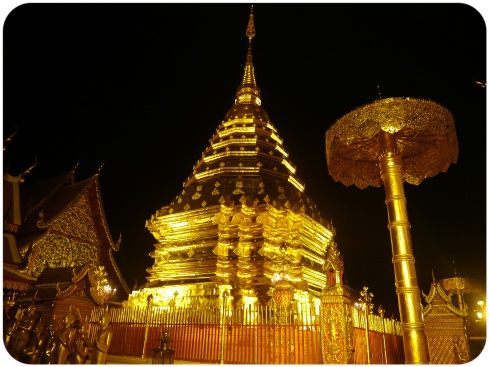
A view of the golden chedi at Wat Doi Suthep at night

A view of the golden chedi at Wat Doi Suthep at night

D
uped. Deceived.
I was screaming all sorts of curses in my head while my calf muscles throbbed from the 309-step descent (and prior ascent) from Wat Doi Suthep. I was sweating profusely even with the cool, mountain breeze, stifling the panic that was rising from the bottom of my gut. I nervously noted the souvenir stalls closing up for the day. Night had fallen.

Save for a Thai lady who I came down the steps with, there were no longer any tourists around and no other vehicles for hire. I saw only one other red car but I wasn’t sure it was the same one. I should’ve remembered to note the plates. I knew I shouldn’t have trusted that man. I shouldn’t have paid him 200 Thai Baht in advance. I felt like such a rookie. He said his name was Matthew. Maybe that was made-up too.

The Red Car Driver, Matthew--A Chiang Mai Local

The Red Car Driver, Matthew–A Chiang Mai Local

Then the slow, bladder sphincter-loosening realization crept in: the red car I had hired to take me here and back to the city had abandoned me.

I mentally skimmed through my options:

a. Walk the entire 15 km-descent back to Chiang Mai. In the dark. NO.
b. Talk to one of the locals who seem to own a scooter and propose a deal. Do they speak English?
c. Go to the police station and ask for assistance. Are they still open?

A view of Chiang Mai from Doi Suthep Mountain

A view of Chiang Mai from Doi Suthep Mountain

I had to clear my head. Before I left for this trip, I had read about the unfortunate plight of a tourist in India. I gave myself a mental smack. I should not have traveled to this country solo. I sat down on the curb and struggled to get the stress hormones down to not-so-toxic levels.

How was I going to get myself home?

I got up and checked the only red car parked by the road. I prayed to the gods that the driver was just taking a nap inside. I couldn’t have taken that long up in the temple! Yes, I was entranced by the monk’s chants and the solitude of the temple over sundown but I couldn’t have been more than an hour!

I peered through the car window. It was empty.

I paced back and forth ranting silently. Then, unceremoniously, there he was, coming down the steps from one of the buildings. In seconds, all the fear dissipated and I resisted the urge to grab this petite man/boy and hug him. I thanked him repeatedly and I was so overjoyed I told him I’d take him to dinner wherever he liked. Of course, I said this with more gestures and in broken English so he could understand. Smiling an unassuming smile, obviously clueless about what I had been through for the past fifteen minutes, Matthew opened the car door for me and asked if I was “happy”.

I told him yes.

Getting to the market, Matthew invited me to make an offering to Buddha at the shrine. He then taught me wai phra and he smiled taciturnly as I lit the incense and silently thanked Buddha.

Lotus blloms for Buddha

Lotus blooms for Buddha

Earlier I had told Matthew he could go anywhere he wanted for dinner and it was on me. That was mostly relief, talking. As we sped away, I berated myself. Again.

We slowed to turn towards a dark alley. My heart jumped to my throat and the tourist in India flashed through my mind one more time. But as we rolled in to a dimly lit parking area right next to a swanky sports car, my fear turned into suspicion. I was getting royally ripped off tonight. The restaurant looked exclusive.

The facade of Huay Kaeaw Restaurant looked rustic and inviting

The facade of Huay Keaew Restaurant looked rustic and inviting

We walked through the restaurant hall while Matthew kept saying this place had “the champion kangsom in all of Chiang Mai”. In my head I thought sourly, “It better be the best, if I’m going to splurge on it tonight”.

The restaurant overlooked   the Huay Keaew waterfall

The restaurant overlooked the Huay Kaew waterfall

Nothing could prepare me for what awaited us though. As we entered the receiving area, I couldn’t help bust gasp at the most beautiful sight that night: we were to dine right next to the Huay Kaew waterfall! Matthew was right about the kangsom too and no, I didn’t spend a fortune.

Buddha must have been smiling down on me that night. And Matthew, well, since that night, he officially became a friend.

It’s a great thing to take precautions for safety but let’s not forget that there are still good people among us. I’m glad to have befriended one along the way.

Beguiling Bangkok

March 18, 2013

To the uninitiated, Bangkok can either be scathing and unforgiving or just plain overwhelming. From the moment I stepped out of the taxi from the airport, arriving in the city on a red-eye flight, I smelled the craziness of the city and that was already 2 in the morning. It seemed that the district where I was to spend my first night in, knew no sleep. I was in Khaosan Road afterall–Bangkok’s party central for tourists and locals alike. The same Khao San road where Leonardo Dicaprio’s character in the backpacker movie The Beach, stayed while in Bangkok.

The party spilled out into the streets mingling with the exotic food (fried scorpions,crickets, cockroaches, etc...) hawkers, souvenir stalls and makeshift stalls selling varied wares.

The party spilled out into the streets mingling with the exotic food (fried scorpions,crickets, cockroaches, etc…) hawkers, souvenir stalls and makeshift stalls selling varied wares.

Delicacies of deep-fried creepy crawlies are aplenty in Khao San Road at night

Delicacies of deep-fried creepy crawlies are aplenty in Khao San Road at night

Entering the Floating Market

The next morning, I felt like I paid too much for the long-tail boat-ride (5000 baht) since my original tour was canceled, but in all fairness to this part of the trip, the morning’s mishaps melted away in the murkiness of of the floating market’s waters. I had the boat all to myself anyway. Yes the Floating Market IS “touristy” but how else should the locals react to the influx of tourists wanting to experience what used to be a way of life in this part of the country for Thai people? I can’t blame them. Although, I have to say, if you don’t want to buy anything from the market, you’ve got to be firm and say NO. If you do say “No” all through out, then expect your tour to be shorter than average.

Many of the items in the floating market are a little pricey so your haggling skills are a must!

Many of the items in the floating market are a little pricey so your haggling skills are goign to come in handy!

Lucky for me, my long-tail boat operator Mr. Mong went out of his way to make this solo-traveler happy. Mr. Mong detoured from the usual tourist route and brought me to the Damnoen Saduak Temple and to a shed where we lazed about for an hour, feeding the fish. Slowly, the not-so-nice impressions and thoughts about this Thailand trip in general, dissipated as Mr. Mong and I patiently–and clumsily–gestured at each other in an effort to communicate.

This Buddhist temple is off the beaten tourist path

This Buddhist temple is off the beaten tourist path

Our long tail boat docked here at this shed so I could walk towards the temple. this spot is very serene and relaxing.

Our long tail boat docked here at this shed so I could walk towards the temple. this spot is very serene and relaxing.

I went back to Bangkok more calm and determined to acquaint myself with the city’s quirks by walking from Khao San Road to the temples beginning with the Grand Palace and Wat Prakeaw. My excitement could no longer be dampened, not even by a scamming Pigeon-Feeder at the park who demanded 100 Baht for a handful of corn she handed to me (I thought she had GIVEN it to me to help her feed the pigeons). “Keep calm and carry on”, I thought to myself over and over after handing her 20 Baht and taking off. There’s too many sights to see, I couldn’t let any bad vibe ruin the experience.

This shot of the stupas of Wat Prakeaw was taken while I walked through Sanam Luang (The Royal Field).

This shot of the stupas of Wat Prakeaw was taken while I walked through Sanam Luang (The Royal Field).

Wat Pho - Temple of the Reclining Buddha is also knows as Wat Phra Chetuphon.

Wat Pho – Temple of the Reclining Buddha is also knows as Wat Phra Chetuphon.

My visit to the temples had me mesmerized and regretful that I had to leave the city too soon to fly out to Chiang Mai. I was only able to visit one other temple after Wat Phra Keaw, and witnessed the magnificence of the 15 meter-high and 43 meter long reclining Buddha in Wat Pho. I stayed for bit and mulled over the paradox that was Bangkok. I looked forward to coming back, after Chiang Mai–and that’s another story.


Swimming with Sea Turtles!

February 12 – 14, 2013

Dgte_Pix002

Travelling to Apo Island from Cebu is grueling, but it is definitely worth it!

Here’s the 411 on getting there from Cebu City:

1. Take a V-hire from Citilink Terminal in N. Bacalso Avenue to go to Liloan Ferry Terminal in Santander for not more than Php250 and the trip will take about 3 to 4 hours.

2. From the Liloan Port, you’ll be taking the ferry boat to Dumaguete which will set you back about Php65.

3. Once in Dumaguete, if you’re travelling with a large group, you can negotiate for an easy ride (public mode of transportation) to take you to Malatapay, where you will be taking the boats to Apo Island. Malatapay is about 45 minutes from Dumaguete City.

4.  When you get to Malatapay, you need to go through the market and then you’ll see the LGU Station that mans the Boat Rentals towards Apo Island.

5. Welcome to Apo Island!

Swimming with the slow, deliberate and graceful Pawikans of Apo Island

Swimming with the slow, deliberate and graceful Pawikans of Apo Island

The rates as of February 2013, are below:

Boat rental rated going to Apo Island

Boat rental rates going to Apo Island

You’ll probably want to aks what other miscellaneous expenses this trip would entail, so I thought I’d give you a break down of what to expect:

1. Apo Island is a protected area, therefore, frolicking in it’s waters will cost you a minimal environmental fee around the figures of Php100.

2. If you don’t have your own underwater camera, there is one you can loan for a fee of Php1300 for the entire day. For that amount, we had to provide our own memory card though.

3. Life vests, snorkeling gear, beach hut rental and flippers are for rent as well, going for Php200 each item.

4. If you’d like to have a guide to spot the sea turtles for you, that would cost another Php300. In our case, the pawikanwere abound and we didn’t really feel the need to hire a guide since we could spot the turtles ourselves even in shallow waters.

5. If you didn’t pack any lunch, you can ask some of the locals to cook up some lunch for you. What’s available varies though, and cooking fee per person was priced at Php75/pax. Good thing our group packed some lunch with us.

6. You may find it a good idea to spare some budget for souvenirs as well. :)

Save the Sea Turtles

Save the Sea Turtles

It was a breath-taking and rare experience, especially with the sea turtles’ steady decline in numbers through the years. If you want to know more about sea turtles and why we should save them, check out an editorial for a local newspaper written by my brother: Why save the sea turtles? (newsinfo.inquirer.net).


An Extreme Eco Adventure!

January 28, 2012

An out-of-the-ordinary experience, Danasan Eco Adventure Park, in Danao Municipality of Cebu, promises an all-natural high with a host of  activities that will get your blood pumping and test your will. Set in the mountains, the park’s serene and seemingly gentle landscape can be quite misleading. But then again, you’ve got to remember that it’s the action you’re coming here for. :)

Image

 Please be forewarned, if you do decide to come here, that this is not for the faint-hearted. It’s also best to  pack the following for a day trip:

1. Extra dry clothes

2. Waterproof/shockproof camera OR a waterproof pack for your cellphones/cameras

3. Good footwear: flimsy beach flipflops will not be a good idea especially if the weather is wet and damp since the ground will be very slippery and muddy.

4. Pain Relievers to take at the end of the day: a full experience of the park’s awesomeness comes with a guarantee of muscle aches, bruises here and there, body pains and a good share of mud on your hair and clothes, so it’s best to be ready!

5. Lots of energy.

Here are some of the activities I tried:

Image

Tyrolean: push your limits and enjoy the rush!

Image

This authentic John Deere tractor will ferry you  from the entrance/restaurant to your adventure destinations such as the waterfalls, the caves or the water park. This ride only looks gentle–wait until you try going through DEEP tire tracks in the mud and have the tractor throw you around the compartment like a ragdoll.

No waterfall-jumps this time, so I decided to rappel down the waterfall instead.

Image

I don’t think the ATV ride would have been as much fun as it was, if it had been sunny and dry that day. The dirt and the mud had to be the key elements!

This park is the first of it’s kind in Cebu and I’m sure it has extreme-adventure enthusiasts excited. The park adventure was a great way to get together with a new team and it made breaking the ice a little less awkward and a little more fun and spontaneous. There’s a lot for everybody to do: wake-boarding, horse-riding, trekking, spelunking (beginner’s and advanced level) and as a matter of fact, you could stay overnight in their accommodations.

For more information, you can drop by their website (link is above) and check out other activities they have going on.


Southern RnR

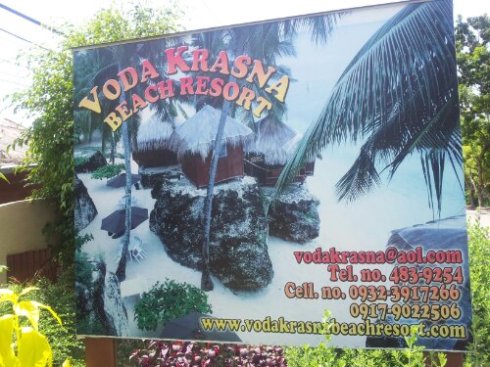
Alcoy was last week’s destination for some well-deserved RnR. We stayed at Voda Krasna which was previously, Kai Nani Pointe. Christine Dormeli was such a gracious host and offered us the spacious and elegant suite room for a discounted price with breakfast included which we took right away.

Cool, relaxing waters of Alcoy

The weather forecast talked about thunderstorms for the weekend but was inaccurate, thankfully.

image

On the way back home after a lunch stop a little past Alcoy, we found a little fishing place where they served grilled panga (tuna jaws) and grilled squid.


The drive back was also pleasant if not for some road repairs which remind me that I am still keeping my fingers crossed for the preservation of Cebu South’s centuries-old trees.

Good old RnR it definitely was. Just another reason why I live for the weekends. :-)


Casa Manila: A Guide to Gracious Living

At the Balcony Gates of Casa Manila

Our guided calesa  tour took us through the well-planned streets and stops in Intramuros. There were many interesting stops but none had more appeal to me than the Casa Manila Museum of the Plaza San Luis Complex, close to the San Agustin church. Casa Manila  is a reconstructed house now showcasing the lifestyle of upper-class members of society during the Spanish Era.

For the affluent few in colonial Philippines, gracious living featured a lot of perks. It was only too bad I couldn’t take shots of the interesting pieces inside Casa Manila Museum but I was very happy to note some quirky facts:

  • In place of the modern day’s electric fan, punkah, which was a large, manual, overhead fan made of textile, had to be imported from India and installed in dining areas. Since electricity was yet to be harnessed for public consumption at the time,  one could make it swing overhead by pulling a cord–serving to cool guests in the hot weather and to shoo flies away.
  • Ice-cold beverages served to guests marked a well-to-do household since in those times since ice cubes actually had to be shipped from the USA. Only rich families could afford to buy them or keep them in an ice chest that had to regularly be fed with salt to keep the ice from melting rapidly.
  • An old school kasilyas or toilet, would be separate from the banyo or the shower room. In the Spanish era, these rooms came with wooden chairs that seated 2 people while doing number 2. The kasilyas not only served as a place to relieve oneself: chit-chats accompanied the time spent inside. As a matter of fact, board games (such as dama) were also brought along for recreation.
  • A bachelor uncle had their very own sleeping quarters at their disposal whenever they came to visit. This room is not a “guest room” as we would presently consider it to be. They were specifically for the use of the “bachelor uncle”.

There were many other interesting facts recounted by the keepers of the museum, but the rest of them escape me now. I can only imagine how ladies in Maria Claras elegantly walked through the halls and how the dashing gentlemen rode their horses through the grounds of the Casa to call on the Master of the house.

This journey back in time will only cost you Php75.00 which you’ll have to pay upon entrance.


Intramuros: Behind the Walls of Old Manila

Clockwise from top right: our calesa driver taking us along one of the calles, The Manila Cathedral, One of the weapons used during the Japanese occupation, Baluarte de San Diego Gardens, our tourguide’s calesa

The historic “walled city” (direct latin translation of Intramuros) is not only an interesting but also, a meaningful way to spend one’s day in Manila. Afterall, Intramuros was Manila in the days of old, founded in 1571–the stronghold of the Spanish Colonial government. As soon as you step into one of Intramuros’ puertas, you could almost hear it’s walls and cobbled streets echo the stories of the Spanish Era and the American Occupation. The structures and old institutions inside Intramuros, also tell of the ravage and destruction that World War II brought about when the Japanese used the fortress as their garrison.

Plaza San Luis Complex right next to the San Agustin Church.

Manila Metropolitan Cathedral-Basilica

Also known as Cathedral-Basilica of the Immaculate Conception. It was closed for renovation as of press time.

Although the walls have mostly been restored from the damage done during WWII, Intramuros still holds that certain wordless charm–the feeling of being transported back in time. Churches such as the Minor Basilica of the Immaculate Conception (Manila Cathedral), San Agustín Church and schools such as the University of Santo Tomas and Colegio de San Juan de Letrán are part and parcel of the most significant heritage that the Spaniards have left us with: Catholicism.

San Agustin Church. Originally known as “inglesia de San Pablo”, founded in 1571 is the oldest stone church (built in 1589) in the Philippines.

Recently this landmark has been getting negative press, quoting from Wikipedia:

“In an October 2010 report titled Saving Our Vanishing Heritage, the Global Heritage Fund identified Intramuros along with Fort Santiago, as one of 12 worldwide sites “On the Verge” of irreparable loss and destruction, citing insufficient management and development pressures.

I only hope that the Philippine government will act swiftly to save this treasure and preserve pieces of the Filipino identity.


Dakit-dakit Island, Cebu

The Great Summer Escape Part 3

It was Day 3 in Malapascua and I was psyched thinking about what I had planned for the day. I was determined to scuba dive and see the wonders below these waters myself. for the Discover Scuba Diving course, we took a small boat out to Dakit-dakit Island which is just about 10 minutes away from Bounty Beach, Malapascua.

My travel buddy succumbed to the agony of her sunburnt skin and decided to hole up in the hotel room which meant I had to do the course solo. It wasn’t so bad though since my instructor assigned his apprentice to be my dive buddy. This is my second time diving–the first, probably not more than 10 years ago. So you can imagine how excited I was to be underwater again. Photos and Videos taken by my instructor. My only regret was that I did not have the camera gear suited for underwater use so I could have documented the beauty 15 meters below, much better.


Kalanggaman Island, Palompon Leyte

 The Great Summer Escape Part 2

Image

On our second day on Malapascua, we hired a boat to take us to an island 2 hours away. Kalanggaman is more than an islet than an island–a sitio that belongs to Pamlompon, Leyte.

ImageWhen our boat slowed to halt by the edge of the shores, we had no words but only cries of awe. Kalanggaman is truly a sanctuary with seemingly-endless sandbars flanking each end. The beach is a long stretch of pristine, powdery white sand lapped up by gorgeous waters in gradients of blue.

 Image

 We paid about Php1500/pax for the trip back and forth inclusive of lunch and assistance by the boatman. Entrance Fee to the island is at Php150.00 for locals and Php500.00 for foreigners. Overnight camping can be done with tents since there are no establishments on the island. You should feel at ease staying on this island with Palompon’s government ensuring safety with a Police force stationed on the island 24/7.

Image

I spent the day snorkeling and baking in the sun taking in the beautiful view and relaxing breeze. We didn’t want to spend the night in Kalanggaman with our accommodations back in Malapascua but we stayed almost until 4 in the afternoon. It’s not advisable to to sail back from the island past 3 or 4 pm as the seas could get very rough plus you’d want to have enough time to be off the waters before nightfall.


Follow

Get every new post delivered to your Inbox.

Join 101 other followers